
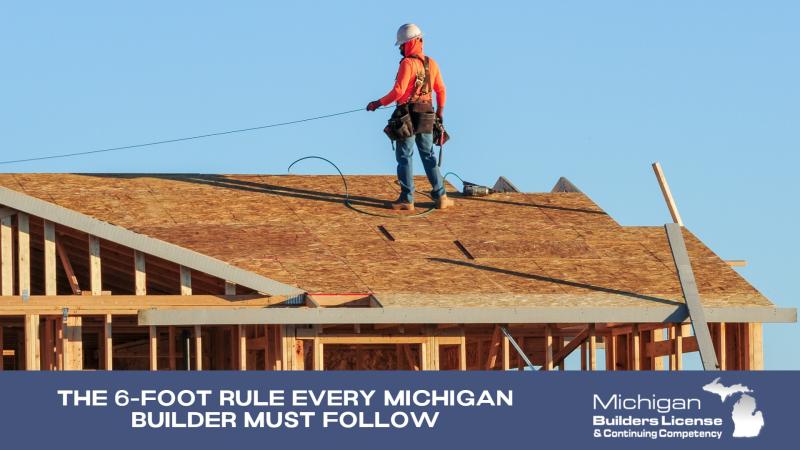
What Residential Builders Need to Know About Fall Protection on Michigan Jobsites
Falls remain the leading cause of serious injuries and fatalities in construction, which is why fall-protection rules are among the most important safety requirements builders must follow.
Many residential contractors assume these rules mainly apply to large commercial projects. In reality, the same core requirement applies to residential construction throughout Michigan:
If a worker is six feet or more above a lower level, fall protection must be in place.
This requirement comes from federal construction safety standards enforced by the Occupational Safety and Health Administration and adopted in Michigan through the state program administered by MIOSHA.
Understanding when the rule applies and what builders must document can help prevent injuries, avoid citations, and keep jobsites running smoothly.
Sid Woryn discusses fall protection in our 3-hour Continuing Competency Course. Watch here!
Understanding the 6-Foot Rule
Under construction safety standards, fall protection must be provided whenever workers are six feet or more above a lower level.
For residential builders, this often occurs during everyday tasks such as:
- Installing roof trusses
- Roof sheathing or decking
- Framing second-story walls
- Building elevated decks or balconies
- Installing siding or trim on upper levels
- Working near open stairwells or floor openings
Even short tasks can require fall protection if workers are exposed to a fall hazard.
According to the U.S. Bureau of Labor Statistics, falls consistently account for the largest share of construction fatalities each year. That is why regulators focus heavily on fall hazards during inspections.
Common Fall Protection Methods Used on Residential Jobsites
The regulations allow several different protection systems. Builders can choose the method that works best for the job site and the task being performed.
Typical options include:
Guardrail Systems
- Top rail around 42 inches high
- Mid-rail installed
- Designed to withstand 200 pounds of force
Personal Fall Arrest Systems (Harness Systems)
- Full-body harness
- Lanyard or self-retracting lifeline
- Secure anchor point rated for 5,000 pounds per worker
Safety Nets
- Less common in residential construction
- Used when other systems are impractical
The key is that whichever system is used must be installed correctly and used consistently.
Where Residential Builders Often Get Cited
One of the biggest misconceptions is that citations only occur when builders lack safety equipment.
Many violations occur because documentation or training records are missing.
Builders should maintain clear records showing that fall protection procedures are part of their safety program.
Common items inspectors expect to see include:
- Worker training records on fall hazards
- Documentation showing workers understand harness use
- Inspection procedures for harnesses and lanyards
- Identification of a competent person responsible for safety
- Written fall protection procedures when required
If these records are missing, inspectors may assume training was never provided.
Roofing and Framing Create the Highest Fall Risks
Residential roofing and framing work consistently present the greatest fall hazards.
High-risk activities include:
- Walking roof edges during sheathing
- Installing roof trusses
- Working near open stairwells
- Framing second-story floors and walls
- Installing exterior siding or trim at height
Planning for fall protection before framing begins often makes compliance easier and safer for crews.
Practical Ways Builders Keep Jobsites Safer
Experienced builders often approach fall protection the same way they approach other parts of construction planning.
Simple steps can make a major difference, including:
- Installing anchor points early in the project
- Keeping harnesses readily available for crews
- Conducting brief job-site safety talks
- Identifying fall hazards before work begins
- Assigning a competent person to monitor conditions
When safety procedures become part of the normal workflow, fall protection becomes much easier to manage.
Learn More in Michigan Builders License’s 3-Hour Continuing Competency Course
Michigan builders must complete continuing competency training to maintain their licenses.
In the Michigan Builders License 3-Hour Continuing Competency course, instructor Sid Woryn covers key jobsite safety topics, including MIOSHA requirements that apply directly to residential construction.
During the course, builders learn:
- How MIOSHA fall protection rules apply on Michigan job sites
- What inspectors typically look for during site visits
- What documentation builders should maintain
- Practical safety insights based on real field experience
If your license renewal deadline is approaching, the course provides clear guidance that builders can immediately apply on the jobsite.
External Sources
Occupational Safety and Health Administration
Construction Fall Protection Standards – 29 CFR 1926 Subpart M
MIOSHA
Michigan Occupational Safety and Health Administration Construction Safety Standards
U.S. Bureau of Labor Statistics
Construction Fatal Injury Statistics


