
OSB buckling isn’t just a cosmetic issue inspectors complain about. It’s a warning sign that a structure may be weaker than intended. In Michigan, where seasonal humidity swings, high winds, and freeze-thaw cycles are common, improper OSB installation can lead to visible wall distortion, call-backs, failed inspections, and even reduced wind resistance.
Not surprisingly, “OSB buckling,” “OSB spacing requirements,” and “wall sheathing nailing patterns” are frequent search topics among builders and remodelers. These problems also come up repeatedly in Continuing Competency code discussions, because they’re still being done wrong on active job sites.
Below are three of the most common reasons OSB buckles, and how to prevent them, based on real inspection findings and code update discussions.
1. Skipping the Required Expansion Gap Between OSB Panels
One of the most common mistakes is installing OSB sheets too tightly together.
OSB is manufactured with a moisture-based expansion allowance. Most panels are stamped “Sized for Spacing”, meaning they are intentionally manufactured slightly undersized to allow for an expansion gap, typically 1/8 inch, at panel edges.
What goes wrong
- Panels are butted tight on walls, roofs, or subfloors
- Seasonal humidity causes panels to expand
- With nowhere to go, OSB bows or buckles
- On walls, this can telegraph through siding; on roofs, it creates visible dips
This issue is especially noticeable in Michigan’s spring and fall, when humidity spikes cause rapid expansion.
Best practice
- Leave 1/8 inch spacing on all non-tongue-and-groove edges
- Do not rely on “tight looks better” thinking “tight” is wrong
- Follow the panel manufacturer’s installation instructions, not habits
Failing to space panels properly is not just a workmanship issue; it’s a violation of the manufacturer’s instructions, which inspectors increasingly cite during structural reviews.
2. Improper Nailing: Nail Guns Are Not the Same as Hand-Driven Nails
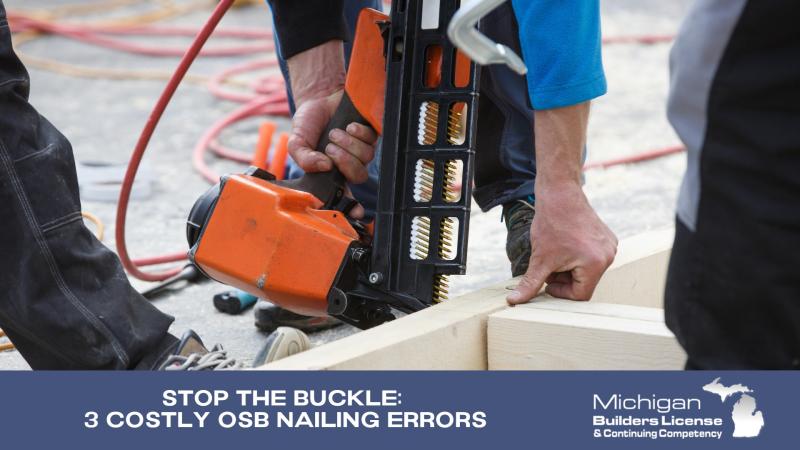
Another major contributor to OSB buckling and reduced structural performance is incorrect nailing, particularly when pneumatic nail guns are treated as equivalent to hand-driven 16d nails.
They are not.
Why nail type matters
- Pneumatic framing nails are thinner in diameter than traditional hand-driven 16d nails
- Thinner nails = less withdrawal resistance
- To compensate, the code requires more nails when using nail guns
What inspectors see on job sites
- Builders using nail guns but following hand-nail spacing
- Missing edge-nailing requirements on sheathing
- Over-driven nails breaking the OSB surface
- Panels attached to subfloor only, not rim joists or framing members
When sheathing is under-nailed or improperly fastened, the wall loses shear strength, a critical component of resisting wind loads.
Best practice
- Follow Table R602 nailing schedules precisely
- Increase nail count when using pneumatic fasteners
- Ensure nails penetrate framing members, not just sheathing or subfloor
- Avoid over-driving nails, which reduces holding power
Improper nailing doesn’t just risk buckling. It weakens the entire load path of the structure.
3. How Poor OSB Installation Reduces Wind Resistance
Many builders think of OSB as “just sheathing,” but in reality, it plays a major role in wind bracing and uplift resistance.
Exterior wall sheathing must resist:
- Shear forces (side-to-side wind pressure)
- Uplift forces (wind trying to lift the structure off the foundation)
When OSB is:
- improperly spaced,
- under-nailed,
- or fastened incorrectly to plates and rim joists,
the wall system becomes vulnerable.
Real-world consequences
Wind-testing and post-storm investigations show that homes often fail not because materials are weak, but because connections are insufficient. Walls can rack, shift, or even slide off floor systems when proper nailing and anchorage are missing.
This is why inspectors focus heavily on:
- Sheathing nailing patterns
- Plate-to-rim-joist connections
- Continuous load paths from the roof to the foundation
Improper OSB installation doesn’t just buckle; it compromises the home’s ability to withstand Michigan wind events.
Wrap Up
OSB buckling is rarely an isolated problem. It’s usually a symptom of:
- Ignoring expansion spacing
- Misunderstanding nail gun requirements
- Treating sheathing as cosmetic instead of structural
These mistakes are avoidable, and they’re exactly the kinds of issues inspectors continue to flag during code enforcement and post-construction reviews.
Learn More in Our 3-Hour Continuing Competency Course
These issues and many others that directly affect inspections, liability, and structural performance are covered in depth by Sid Woryn in the Michigan Builders License 3-Hour Continuing Competency Course.
Sid breaks down:
- Proper OSB installation and spacing
- Correct nailing methods and why they matter
- How sheathing affects wind resistance and structural integrity
- Real inspection failures and how to avoid them
If your goal is to reduce liability, avoid costly rework, and pass inspections the first time, this course is essential. Click here to see our 3-Hour Continuing Competency Course.
Sources & Further Reading
- APA – The Engineered Wood Association: OSB Installation & Spacing Guidelines
- International Residential Code (IRC), Section R602 – Wood Wall Framing
- Simpson Strong-Tie – Shear Wall & Load Path Education
- FEMA Building Science – Wind Resistance & Structural Load Paths


